Competition pool dimensions and requirements
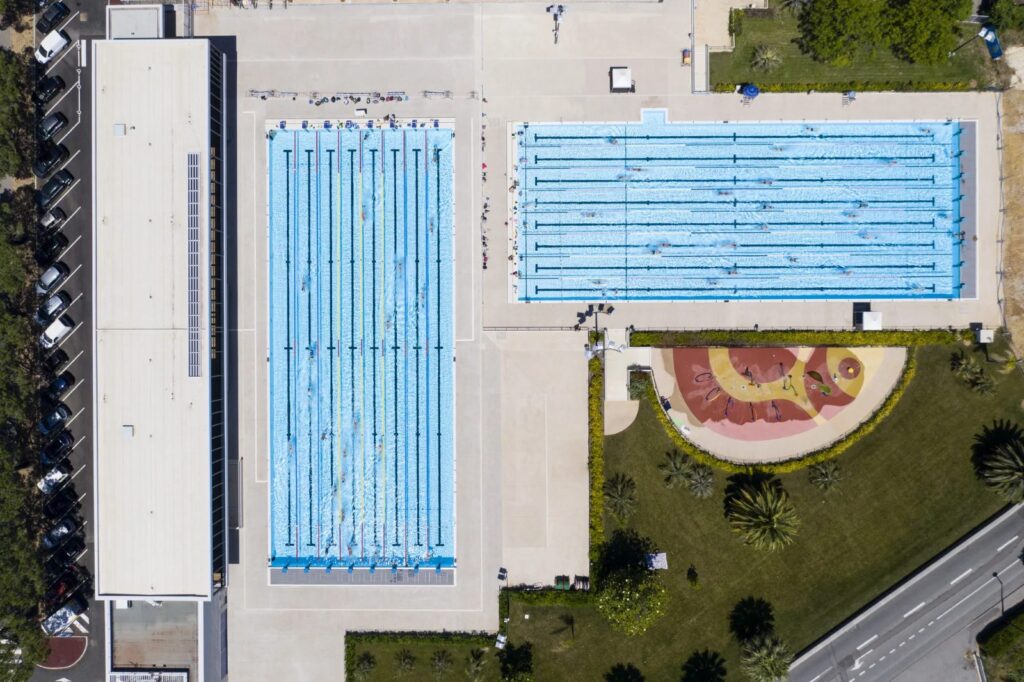
Under World Aquatics rules, a 50 m pool with touch pads at both ends measures 50.020 to 50.030 m wall to wall. Lanes are at least 2.5 m wide, water is 25 to 28 °C, and start zones are at least 1.35 m deep.
Length and tolerance
World Aquatics publishes its pool requirements in the Competition Regulations, Part Two, article 15. The Swimming Pool Certification document has applied since 1 April 2026, and the figures on this page come from it. With touch pads at both ends, exactly 50.000 m remains between the pads.
| Situation | Requirement (World Aquatics, CR Part Two, 15.2) |
|---|---|
| 50 m, distance between touch pads | 50.000 m, tolerance +0.010 / −0.000 m |
| 50 m, touch pads at both ends: wall to wall | min. 50.020 m, max. 50.030 m |
| 25 m, touch pads at both ends: wall to wall | min. 25.020 m, max. 25.030 m |
| 25 m, touch pad at one end: wall to wall | min. 25.010 m, max. 25.020 m |
| Height range over which the length must hold | from 0.300 m above to 0.800 m below the water surface |
End walls must be vertical and parallel, within ±0.3 degrees, with a slip-resistant surface to at least 0.8 m below the water. The pool must be square: corners within ±0.05 degrees, and the two diagonals may differ by no more than 10 mm.
Width, lanes and depth
- Lanes: at ordinary competitions there is no minimum number. Lanes are at least 2.5 m wide; the two outer lanes at least 2.4 m, with at least 0.1 m clear on the outside.
- Olympic Games: eight lanes of 2.5 m, with a 2.5 m clear strip on both sides. World Championships: ten lanes.
- Pool width: for the Olympic Games and World Championships, at least 25.000 m (permanent pool) or 26.000 m (temporary pool). There is no minimum width for other competitions.
- Depth: for the Olympic Games and World Championships, at least 2.5 m; for the short-course (25 m) World Championships at least 2.0 m (2.5 m recommended). At other events at least 1.0 m, and 1.35 m from 1.0 m to at least 6.0 m from the end wall where starting blocks are used.
- Rest ledges along the walls are allowed, at least 1.2 m below the surface and 0.1 to 0.15 m wide.
Equipment, water and lighting
Touch pads, starting blocks and equipment
- Touch pads: at least 2.4 m wide, 0.9 m high and 0.01 m thick; 0.3 m above and 0.6 m below the water surface. An end-wall gutter must allow the pads to be fixed up to 0.3 m above the water. In pools with a perimeter overflow, a removable headwall solves this.
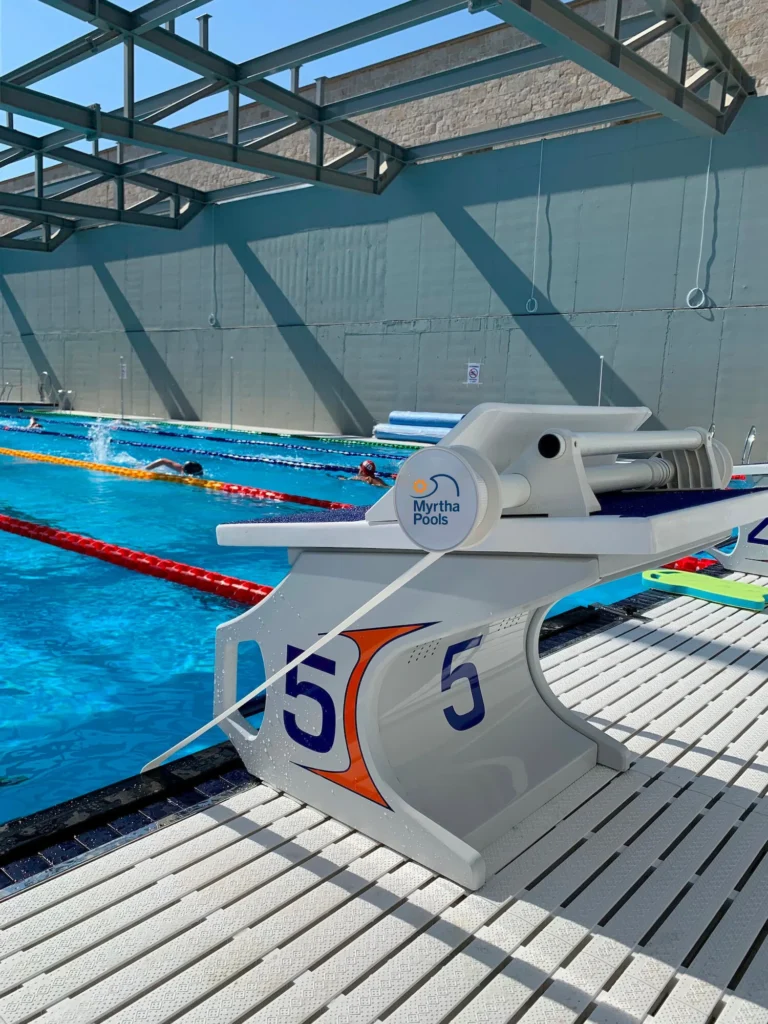
- Starting blocks: platform 0.50 to 0.75 m above the water, at least 0.5 × 0.5 m, slope no more than 10 degrees. See starting blocks.
- Backstroke: flag lines 1.8 m above the water, 5.0 m from each end wall; a backstroke ledge adjustable to 4 cm above or below the waterline. See the backstroke start system.
- Movable bulkhead used as an end wall: a movable bulkhead must span the full width, be stable and vertical, take touch pads from 0.8 m below to 0.3 m above the water, and have no hazardous openings.
- Lane markings: dark lines 0.2 to 0.3 m wide, 46.0 m long in a 50 m pool and 21.0 m in a 25 m pool, ending 2.0 m from the wall with a 1.0 m cross line.
Water and lighting
- Water temperature: 25 to 28 °C.
- Flow during competition: 220 to 250 m³/h in a 50 m pool and 120 to 150 m³/h in a 25 m pool, with no appreciable current. World Aquatics tests this with a floating ball. Outside competition, national health rules apply.
- Lighting: at the Olympic Games and World Aquatics events, at least 1,500 lux over the whole pool; at other competitions, at least 600 lux over the starting blocks and turning ends.
Survey and certification
A pool is certified on the basis of a survey by a certified surveyor appointed or approved by the national federation: KNZB (Netherlands), Belswim with Zwemfed and FFBN (Belgium) or FLNS (Luxembourg). The survey uses a total station (angle 1″, distance 1 mm + 1.5 ppm), with a calibration certificate no more than one year old. Length is measured with the pool full, in the centre of each lane and without touch pads, at a water temperature of 25 to 28 °C. As-built drawings with water depths are part of the submission.
In the Netherlands, the KNZB Swimming Pool Handbook (renewed 16 April 2025) is the reference for facility requirements, competition facilities, water quality, sustainability and accessibility. It is a free download from knzb.nl. The official survey is arranged through the national federation.
How renovation restores the dimensions
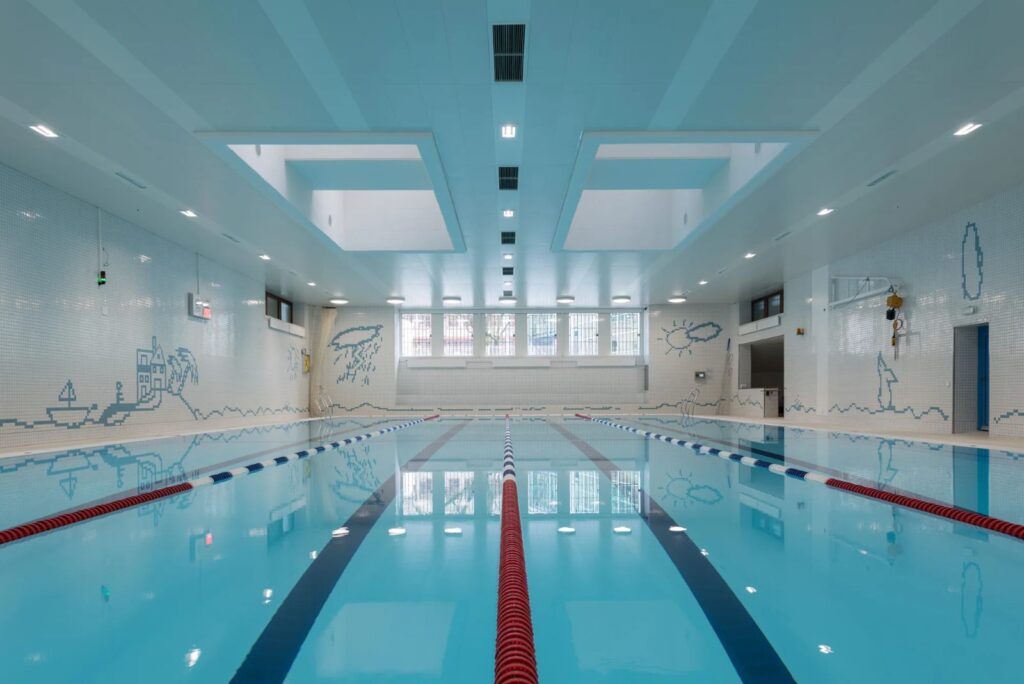
Many competition pools from the 1970s and 1980s no longer meet current requirements: the length no longer falls within tolerance, or there is no room for touch pads. With Myrtha RenovAction, a new stainless steel pool is built inside the existing concrete shell. Stainless steel rails are aligned along the old walls, and spacers absorb irregularities in the concrete. The new structure therefore sets the internal dimensions, not the old concrete. A movable bulkhead can also divide a 50 m pool into two 25 m pools. More in Renovating a sports pool without demolition.
See Renovating a sports pool without demolition.
Example: the 50 m pool at the Twentebad in Hengelo (50 × 20.98 m, up to 3.79 m deep) was renovated in 2018 with Myrtha RenovAction and fitted with a movable bulkhead. It is a Myrtha pool in the BeNeLux.
Myrtha is an official partner of World Aquatics, and Myrtha technology has been used at the Olympic Games since Atlanta 1996, most recently Paris 2024.
Frequently asked questions
How long must a 50 m pool be exactly?
With touch pads at both ends, between 50.020 and 50.030 m wall to wall, leaving 50.000 m (+0.010 / −0.000 m) between the pads. The length must hold from 0.3 m above to 0.8 m below the surface.
How deep must a competition pool be?
For ordinary competitions at least 1.0 m, and 1.35 m from 1.0 to 6.0 m from the wall where starting blocks are used. For the Olympic Games and World Championships at least 2.5 m.
How wide is a competition lane?
At least 2.5 m. The outer lanes may be 2.4 m, with at least 0.1 m clear on the wall side.
What water temperature applies?
25 to 28 °C, both during competition and during the survey.
Who surveys a competition pool?
A certified surveyor appointed or approved by the national federation, using a calibrated total station. The national federation is KNZB (Netherlands), Belswim with Zwemfed and FFBN (Belgium) or FLNS (Luxembourg).
Can an existing pool be brought back to competition length?
Often, yes, by building a new stainless steel pool inside the existing shell, whose new walls set the internal dimensions. A survey of the shell shows whether this works for your pool.
Discuss your competition pool? Do you want to know whether your pool can meet World Aquatics requirements again, or are you writing a brief for a new competition pool? Get in touch.
Read also: Sport, Competition equipment, Movable pool floors.
Sources
World Aquatics, Swimming Pool Certification (in force from 1 April 2026)
World Aquatics, Facilities
World Aquatics, Competition Regulations
KNZB, Swimming Pool Handbook renewed, 16 April 2025 (Dutch)
KNZB, Swimming Pool Handbook download (Dutch)
Myrtha Pools, Sport
Myrtha Pools, Pool renovation (RenovAction)
EWAC Pools, Twentebad Hengelo
Last updated: 28 September 2026
Products
Related products
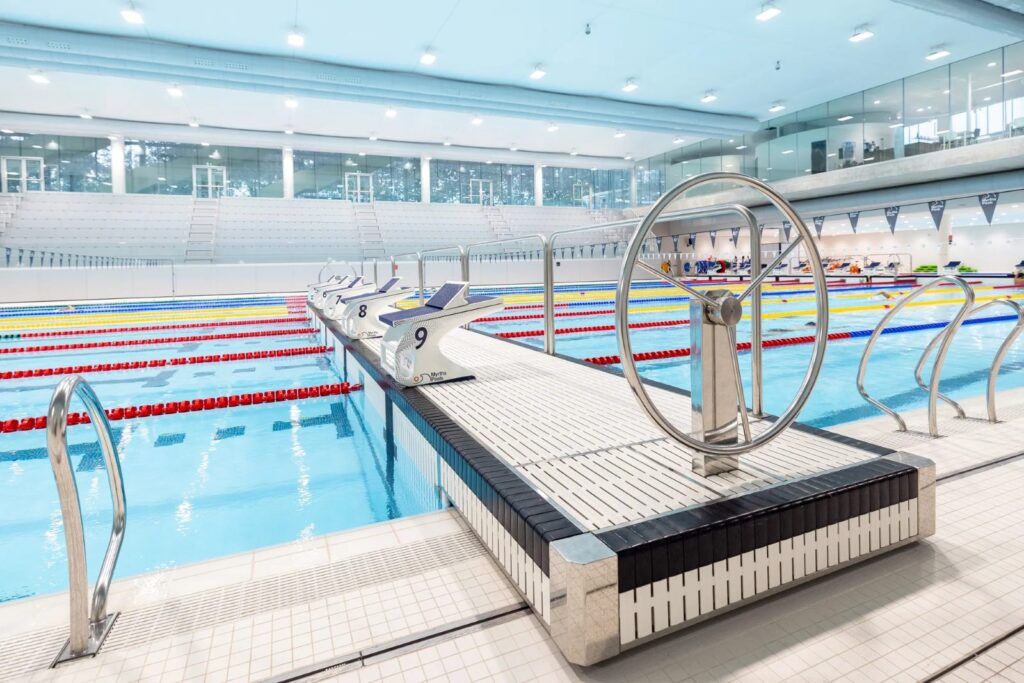
Movable bulkhead
A movable bulkhead divides the pool into zones, so competition, training, lessons and recreation can run at the same time.
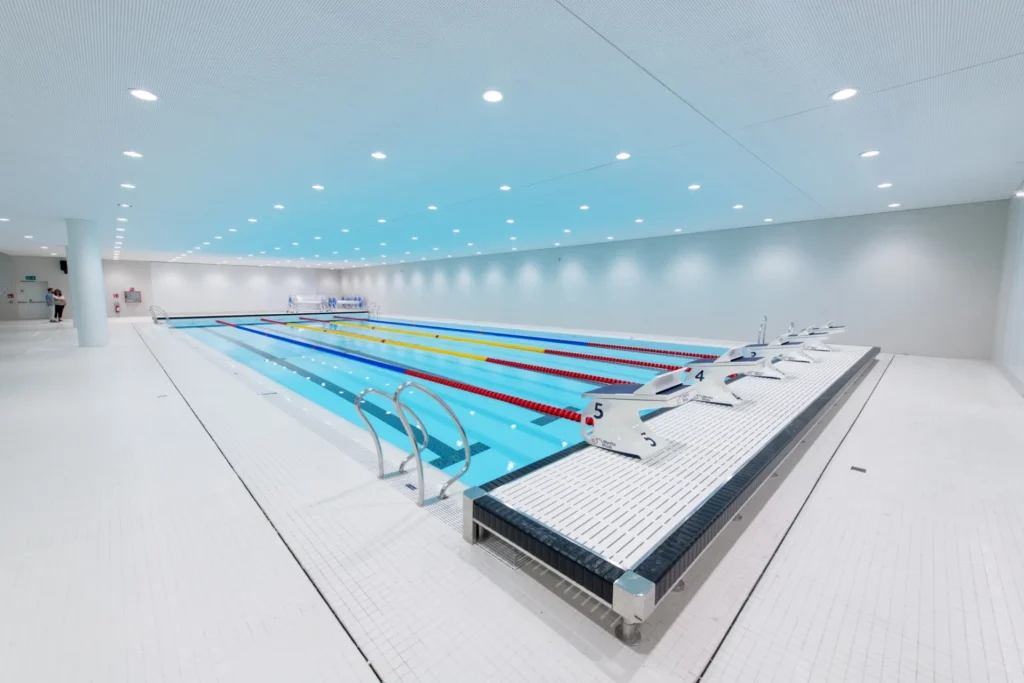
Removable headwalls
Headwalls that create the raised end wall competition requires, without interrupting the perimeter overflow edge.
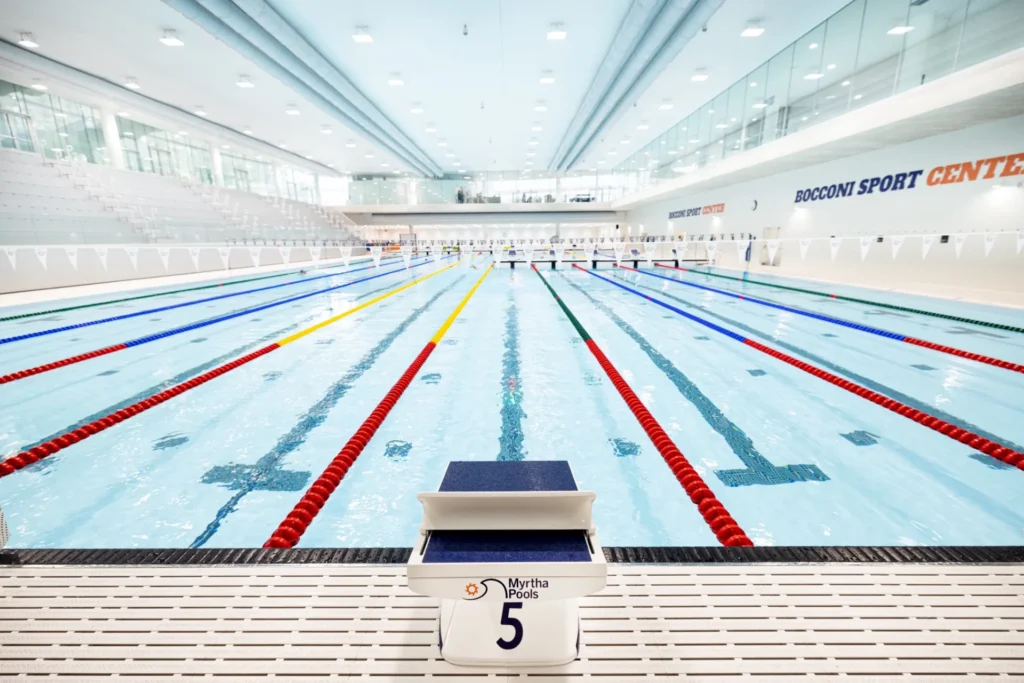
Starting blocks
World Aquatics approved starting blocks with an inclined platform and adjustable rear step, compatible with all common timing systems.
Backstroke start system
A World Aquatics approved foot support for backstroke starts, height adjustable and removed quickly after the start.
Pool Renovation
Renovate an ageing public or sports pool within the existing shell. Stainless steel with Myrtha RenovAction: limited demolition, shorter closure.