How does a movable floor work?
A movable floor is a platform inside the pool that moves up and down. Water flows through openings in the deck and around its edges, so the pool stays full. From a control panel, the operator selects a preset depth.
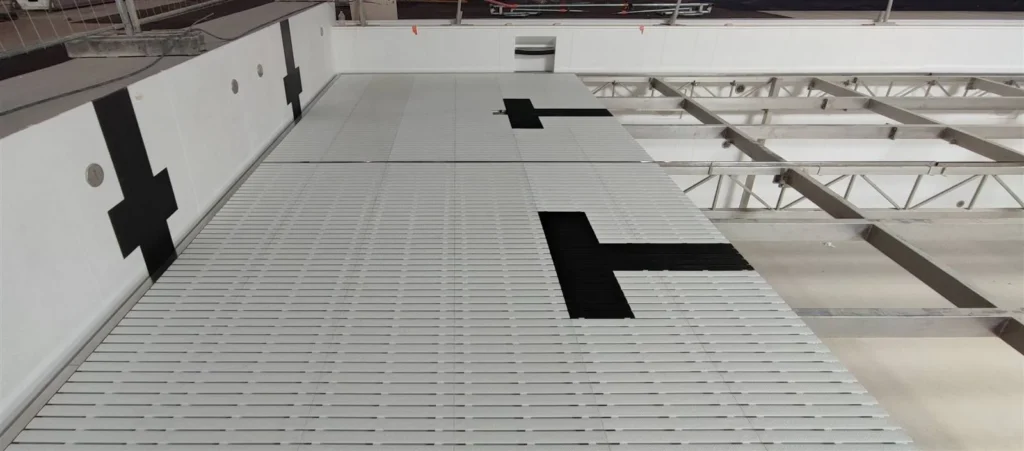
Four types of mechanism
The operator selects a depth for lessons, aqua fitness or training. At its highest position, the floor turns the pool into a walkable surface. How this is achieved differs between systems. The choice affects what must be prepared in the pool shell, how maintenance works and whether the floor can go into an existing pool.
1. Floating platform. Buoyancy tanks make the platform want to rise, and cables pull it down to the required depth. In Myrtha’s version, the hydraulic cylinders driving the cables sit outside the pool. ISI Pools uses submerged tie-rods (“type 1” under EN 13451-11). There is little mechanism beneath the platform, but the pool must contain water for the floor to move.
2. Scissor mechanism (pantograph). A scissor structure beneath the platform, driven by mechanical or hydraulic actuators, keeps it level in every position. A mechanical system also moves in an empty pool (“type 2” at ISI).
3. Wall-integrated. Screw-jacks built into the pool walls carry the platform. Nothing mechanical stands on the pool floor, and the system puts no structural load on it. Myrtha describes it as suitable for both concrete and stainless-steel pools.
4. Movable floors by EWAC Medical (smaller pools and therapy). EWAC Medical builds two types. The suspended floor (up to 45 m²) hangs from cables anchored in the pool walls; a water-hydraulic cylinder in the frame pulls in the cables. The floating floor (from 45 m², up to about 140 m²) contains buoyancy tanks and is raised and lowered by a water-hydraulic cable system. More on the EWAC Medical product page.
Controls, safety and speed
- Preset positions. The operator stores depths for each activity. ISI uses a PLC with touchscreen in a stainless IP56 cabinet, Ethernet remote access and a movement log.
- Visible depth. Poolside LED displays show the current depth and can show a no-diving warning (ISI).
- Emergency stops and locking. EN 13451-11 sets the requirements and test methods for movable floors and movable bulkheads in public pools. [CHECK: standard safety features per product line]
Speed and depth range
ISI floors move at up to 500 mm per minute. The depth range depends on the pool shell. A floor can travel from full depth to “level zero” (Son Hugo, Palma) or above the waterline to close the pool (ISI).
Water quality and maintenance
A floor must not block circulation. Decks are therefore perforated (polypropylene at ISI) or have an open, completely water-permeable structure (EWAC Medical), so water keeps moving beneath the platform. According to EWAC Medical, its floor meets the EN 15288:2008, Annex A dye test.
Maintenance
Myrtha recommends an annual check of drives, cylinders or motors, guides, safety devices and emergency stops. The EWAC Medical floor has a deck of removable polyester tiles, and ISI floors have inspection and cleaning hatches. For maintenance over the full service life, see Maintenance and life-cycle cost.
New or existing pool?
In a new pool, recesses, anchors and cable ducts are designed in from the start. For an existing pool, the supplier first carries out a structural survey. Myrtha lists the phases as survey, design, platform definition, installation, testing and certification.
In practice
At De Waterlinie in Culemborg, a full-length floor runs through a 25 × 21 m Myrtha pool. A hinged wall divides it into two zones 2–3 °C apart. For competitions, the wall folds down and the floor drops to its lowest position.
Frequently asked questions
Does the pool have to be drained to change depth?
No. Water flows through and around the platform as it moves.
Can a floating floor sink?
A floating platform is buoyant and is pulled down by cables. Safety provisions differ by system [CHECK: wording per product line].
Which floors work in an empty pool?
Mechanical systems (scissor or wall jacks). Floating systems need water.
How thick is a movable floor?
It varies by type and manufacturer, and it determines the extra pool depth required [CHECK: build-up heights for Myrtha and ISI].
Is there oil in the pool?
Not with the EWAC Medical floor, which is water-hydraulically operated. In Myrtha’s floating system, the hydraulic cylinders sit outside the pool.
Choosing a floor for your pool? Read Movable pool floors or get in touch.
Read also: Teaching pool with a movable floor, Movable pool floor cost: what drives it.
Sources
Myrtha Pools, How does a movable pool floor work?
ISI Pools, Fondi mobili
EWAC Medical, Movable swimming pool floor
BSI, EN 13451-11:2022
Myrtha brochure Movable Floor, pp. 4–10
Last updated: 28 September 2026
Products
Related products
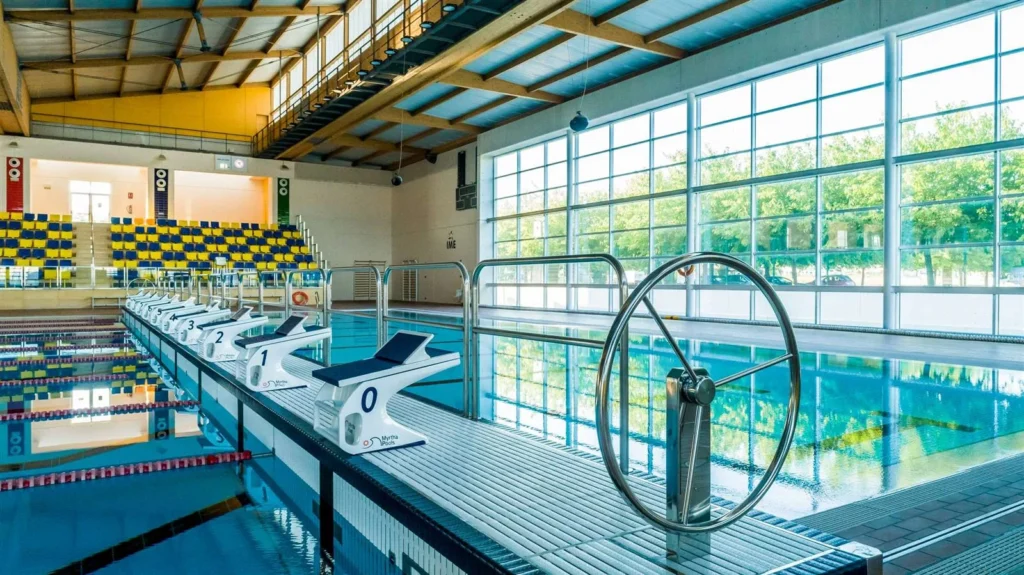
Movable swimming pool floor
Movable pool floors for every pool size: Myrtha movable floors for public and competition pools, and EWAC movable floors for smaller pools.
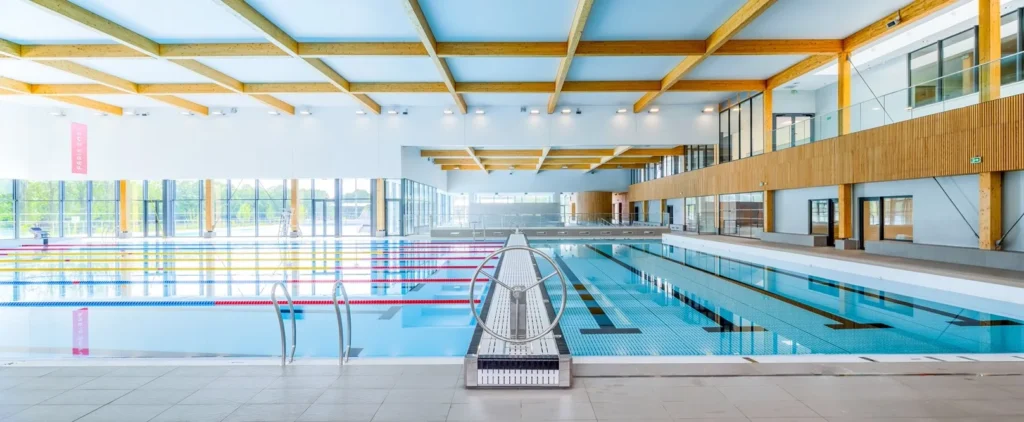
Movable bulkhead
A movable bulkhead divides the pool into zones, so competition, training, lessons and recreation can run at the same time.
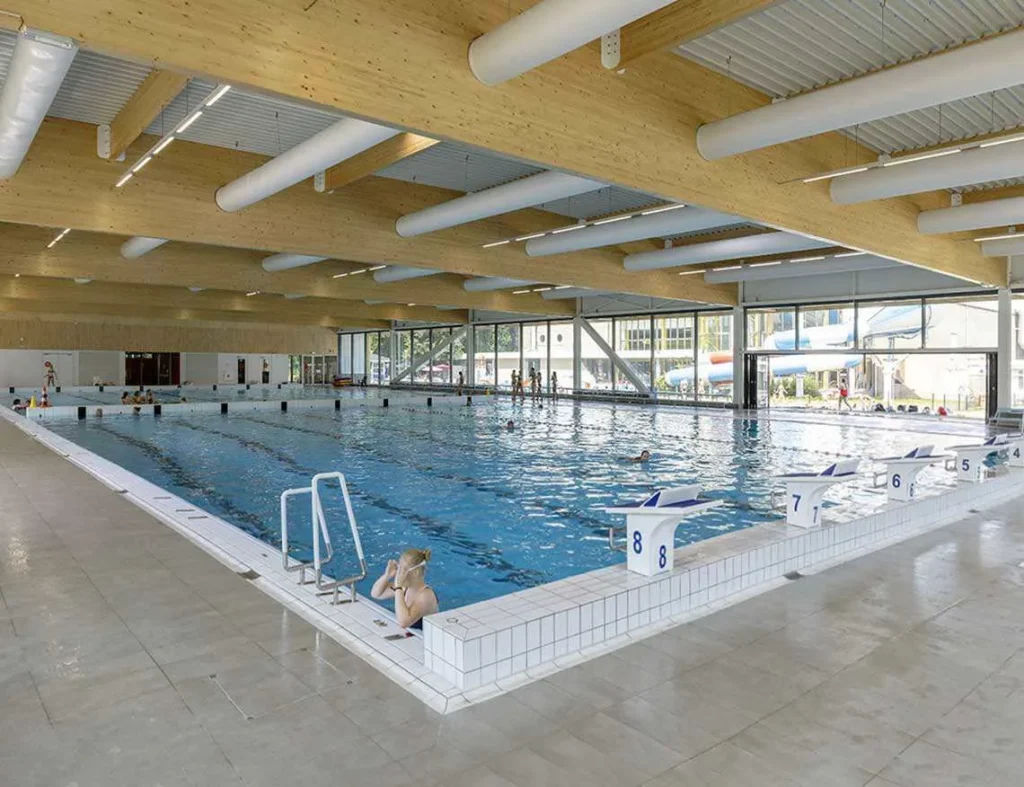
Pool Renovation
Renovate an ageing public or sports pool within the existing shell. Stainless steel with Myrtha RenovAction: limited demolition, shorter closure.